
The Hidden Compliance Risk in Private Clinic Enquiry Forms
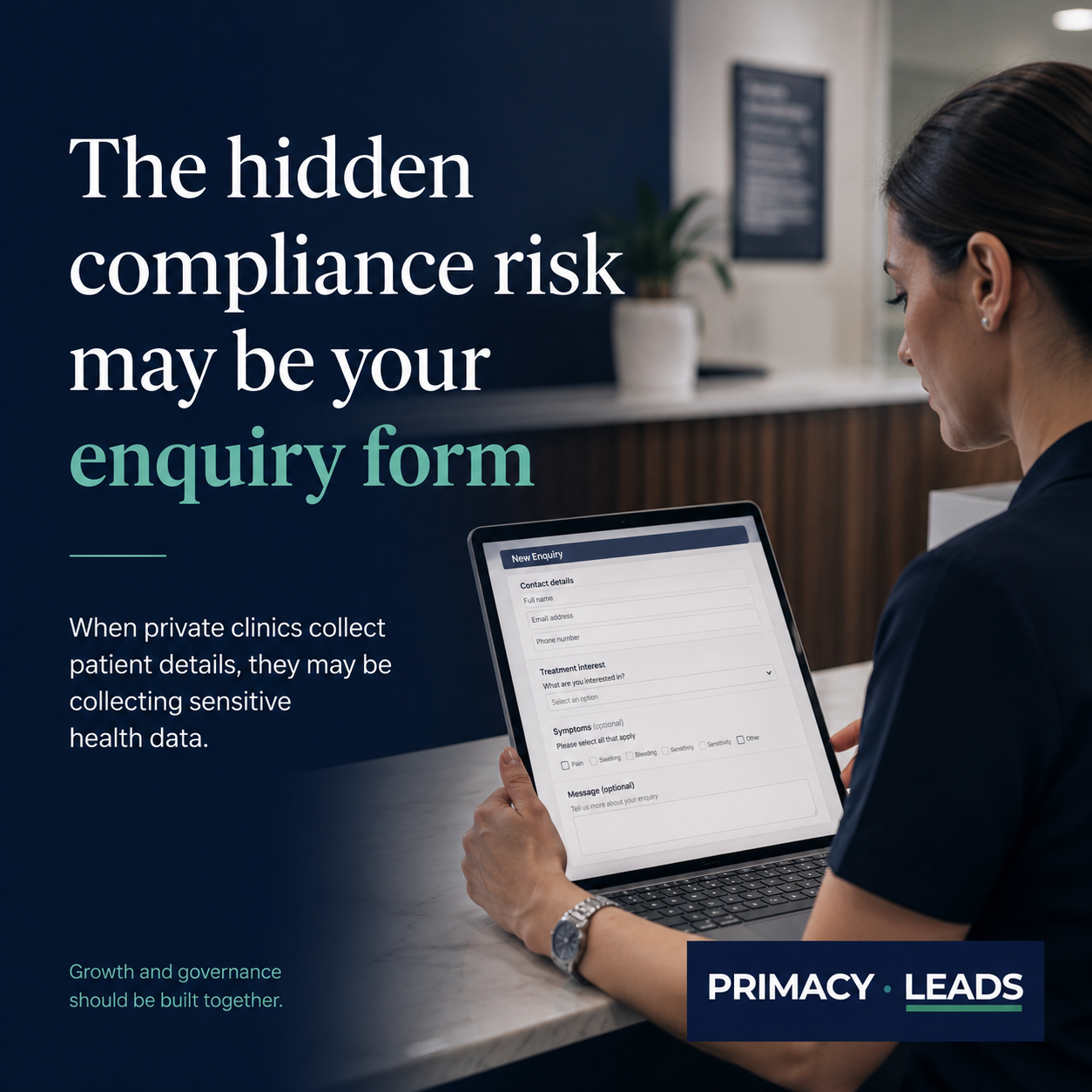
In private healthcare, an enquiry form can quickly move from simple lead capture to sensitive patient information. The design of that journey matters.
Private healthcare clinics are becoming more sophisticated at patient acquisition. A few years ago, many clinic websites were little more than digital brochures. A homepage, a treatment list, a phone number and a contact form were often enough.
That is changing quickly. Today, private dental practices, skin clinics, aesthetics clinics, pharmacy clinics and specialist medical providers are adding more advanced conversion infrastructure:
WhatsApp enquiry buttons
AI chatbots
callback forms
treatment suitability forms
online booking systems
virtual consultation forms
tracking pixels
automated follow-up sequences
treatment-specific landing pages
Commercially, this is the correct direction. Patients expect convenience. They want fast answers, easy next steps and lower-friction ways to enquire. But there is a hidden issue. In private healthcare, an enquiry form is not always just an enquiry form.
The moment a lead becomes health data
A normal business might ask:
What is your name?
What is your email?
What service are you interested in?
For a clinic, the questions often go further:
Are you experiencing hair loss?
Are you interested in weight-loss treatment?
Do you have acne scarring?
Are you considering dental implants?
Are you looking for hormone support?
Are you seeking ADHD assessment?
Are you pregnant or breastfeeding?
Have you had previous treatment?
What medication are you taking?
At that point, the clinic may no longer be collecting ordinary sales information. It may be collecting sensitive health-related information. This matters because healthcare enquiries sit much closer to clinical intake than ordinary marketing capture.
A patient filling out a dental implant suitability form is revealing something about their oral health. A menopause enquiry form may reveal symptoms, treatment history or hormone concerns. A hair restoration form may reveal medical and psychological concerns around hair loss. A skin clinic form may capture acne, pigmentation, scarring, rosacea, injectables or medication history. This is why clinics need to stop thinking about enquiry forms as simple marketing tools. They are patient acquisition infrastructure. And patient acquisition infrastructure needs governance.
The commercial problem
From a marketing perspective, the goal is simple - make it easier for hesitant visitors to become enquiries. That usually means:
shorter forms
clearer calls to action
WhatsApp access
treatment-specific landing pages
online booking
automated replies
faster follow-up
better patient segmentation
These are all useful. But if they are added without thought, the clinic can accidentally create a data and governance problem. For example: A clinic may add a chatbot that asks clinical questions without making clear what the chatbot can and cannot do. A landing page may collect sensitive treatment information without clearly explaining how that information is used. A form may send patient information into a generic inbox shared by non-clinical staff without a clear access policy. A tracking setup may monitor behaviour on sensitive treatment pages without the clinic fully understanding what data is being captured. A follow-up sequence may treat a patient’s health enquiry like an ordinary commercial lead. That is where the risk appears. Not because the clinic intended to do anything wrong. But because growth tools designed for ordinary businesses are being dropped into healthcare journeys.
The patient trust issue
This is not only a legal or compliance problem but also a trust problem. A patient considering a private medical, dental or aesthetics treatment is often hesitant. They may be anxious, embarrassed, price-sensitive or uncertain. If the enquiry process feels careless, generic or overly sales-driven, it can weaken trust before the consultation even happens. Good patient acquisition should do the opposite. It should make the patient feel:
understood
safely guided
properly routed
not pressured
clear on what happens next
confident that their information will be handled appropriately
That is the difference between a lead-generation form and a healthcare patient pathway.
What a PrimacyLeads system looks like
A stronger clinic enquiry system should do five things.
1. We capture only what is needed at the first step
At the first step, we usually reduce friction. For many visitors, this means capturing basic contact details first:
name
email or phone
treatment interest
More sensitive or detailed questions should be introduced carefully and only when they are genuinely useful.
2. We separate commercial intent from clinical triage
A clinic should know whether someone is interested in implants, Invisalign, acne treatment, hair restoration, menopause support or injectables. But the system should avoid pretending to diagnose. Hence the goal of our first pathway is not to replace clinical judgement, but rather to route the patient safely to the right next step.
3. We explain what happens after submission
Standard clinic forms simply say: “Submit.” Our forms tells the patient what comes next. For example:
“Our team will review your enquiry and contact you to arrange the most appropriate consultation route.”
That small detail matters as uncertainty kills conversion, leading to leakage.
4. We establish strict trail as to where the data goes
Instead of disappearing into the generic inbox without structure. We design the data trail post enquiry-submission to enable the practice team to understand:
who receives the enquiry
who can access it
how quickly it is reviewed
how it is stored
how long it is kept
what happens if it contains sensitive information
when clinical staff need to be involved
This is operationally boring. But it is exactly the kind of boring infrastructure that protects both patient trust and clinic growth and what we get paid to do.
5. We make follow-up appropriate to healthcare
The current standard modus operandi on dealing with a patient who enquires about a medical or dental concern is to treat them like someone who abandoned a shopping basket.
Our follow-up qualification is designed to be commercially useful, while remaining proportionate, respectful and appropriate to the context. Where we pay attention to the tone, the timing and the content used in the follow up in order to avoid making the patient feel chased, pressured or treated as a commodity.
Where we see a real opportunity for practices and clinics
Many private clinics think their website has a traffic problem. Sometimes that is true. But often the bigger issue is what happens after the visitor arrives. The clinic may already have demand. The leak is between:
website visit → enquiry
enquiry → callback
callback → consultation
consultation → treatment acceptance
We advise those clinics to not try to solve this by adding more generic forms or more aggressive advertising. Instead, build patient acquisition systems that are commercially effective and clinically appropriate. And in non marketing speak, that means:
easier enquiry routes
clearer patient segmentation
safer data capture
faster response
better consent architecture
stronger governance
more useful follow-up
cleaner conversion tracking
Growth and governance should not be enemies. In private healthcare, they should be built together. Because the future of clinic growth is not just more leads. It is better-routed, better-handled, trust-preserving patient demand.